China’s smart charging cabinets are designed to organize, charge, and protect multiple devices in one managed space. They are used in settings such as schools, offices, workshops, and service centers, where tablets, laptops, or handheld equipment need reliable charging. What makes a charging cabinet "smart" is not simply its appearance or number of outlets. The difference lies in features that help users monitor charging, manage access, and reduce avoidable risks.
Depending on the model, a cabinet may include intelligent power distribution, temperature monitoring, device-level status indicators, timed charging, or remote management tools. These features can help staff spot an inactive slot, identify an overheating compartment, or prepare devices before a shift begins. Details matter. A clear display and well-labeled bays can be more useful than a complicated app that nobody checks. Smart features also vary by manufacturer, so buyers should confirm what is included rather than assume every cabinet offers the same controls.
A practical evaluation should consider capacity, ventilation, charging compatibility, safety protections, and the time required for daily maintenance. It should also ask how the system behaves when connectivity fails. That part is easy to overlook. Smart charging can improve visibility and routine management, but it does not eliminate human checks or guarantee perfect performance. This guide explores the technologies behind China’s smart charging cabinets and explains which features provide meaningful value in real operating environments.
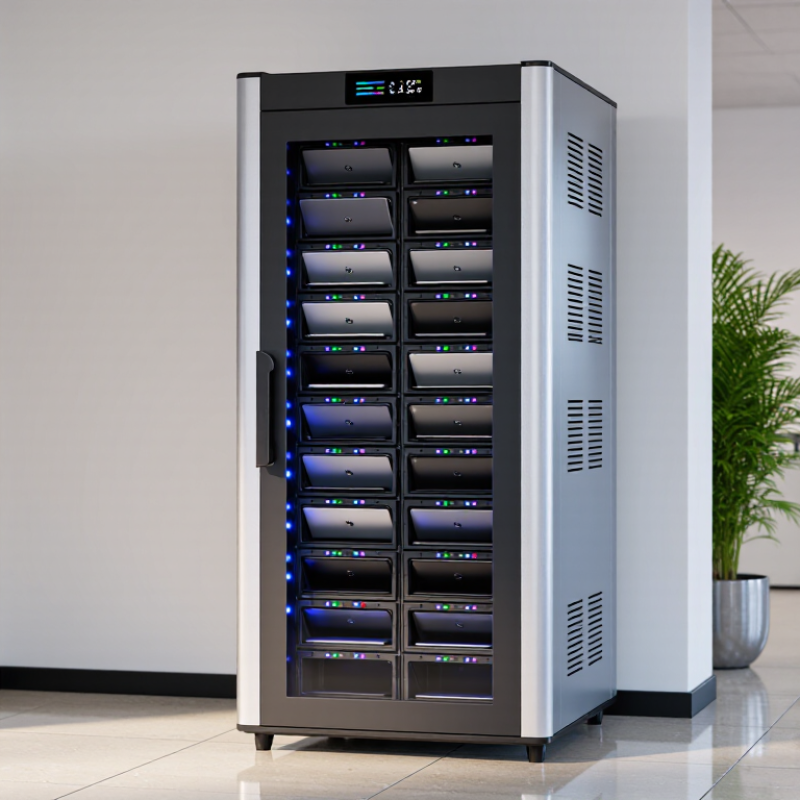
A smart charging cabinet is more than a locked box with power outlets. It combines a secure enclosure, charging modules, wiring, sensors, and a controller that coordinates charging. Inside, cable routing and ventilation matter: crowded leads can block airflow, while loose connections may cause unreliable charging. That matters.
Ports vary by cabinet design. Common options include AC outlets, USB-A, and USB-C, but not every port supports the same output. A clear port label helps users match devices to suitable connections. Some cabinets also assign each bay an individual channel, so a technician can identify which device is charging or drawing too much power.
The control logic manages power delivery and monitors conditions such as temperature, current, and door status. If a channel reports a fault, the controller may stop power to that bay and record an alert. Administrators can often set charging schedules, view usage records, or restrict access with a keypad or staff card. Not always. A “smart” label does not guarantee accurate sensing or useful reports; these functions should be checked against real operating needs. A short test with mixed devices can reveal uneven charging, awkward cable reach, or alerts that arrive too late.
A smart charging cabinet can use its control system to negotiate a compatible USB-C Power Delivery profile with a connected device.
USB PD 3.1 defines fixed voltage options of 5, 9, 15 and 20 V in the Standard Power Range, with 28, 36 and 48 V options in the Extended Power Range. Not every charger, cable or device supports every profile; the negotiated voltage and available power depend on the connected equipment.
China’s e-bike fleet is already enormous. China Bicycle Association industry estimates place the number in use above 350 million. That figure means charging is not an occasional task; it happens daily in apartment blocks, shared courtyards, and roadside parking areas. The National Fire and Rescue Administration recorded about 21,000 e-bike fires in 2023, a 17.4% rise from the previous year. That matters. A charging cabinet can help manage this everyday risk by assigning charging slots, monitoring electrical conditions, and cutting power when abnormal heat or current is detected. Users also gain a clear place to charge, rather than relying on loose cables near doors or stairwells.
“Smart” should mean more than a locked metal box. Sensors, timed charging, and remote status alerts can help operators spot faults and respond sooner. In a busy residential building, a caretaker might see an alert before a resident notices smoke or a burning smell. Still, no cabinet solves every risk. Poor installation, damaged batteries, or ignored alarms can undermine its safeguards. With hundreds of millions of bikes in circulation, reliable equipment and routine maintenance matter just as much as connected features.
A smart charging cabinet manages each port independently, rather than treating every bay as one outlet. If one battery is nearly full, its port can reduce or stop current while another continues charging. This helps balance available power and gives technicians a clearer view of cabinet use. Small details matter. A status light can show charging, completion, or a fault without opening the door. The International Energy Agency’s Global EV Outlook 2024 reported that public charging points worldwide grew by 40% in 2023, reaching nearly four million. That expansion makes reliable monitoring increasingly useful, though the figure describes public EV chargers, not battery cabinets specifically.
Battery data adds another layer. Depending on the battery and charger, the system may read voltage, temperature, state of charge, or fault codes; it cannot assume every pack shares the same data. A port can use available readings to adjust charging or flag unusual heat. Cloud alerts can notify staff when a port stops unexpectedly or a temperature threshold is exceeded. That is not magic. Alerts need sensible thresholds, stable connectivity, and someone who responds. In practice, a loose connector or blocked vent may trigger a warning before a battery problem is obvious, but noisy alerts can also be ignored. Clear logs help teams check what happened and when.
China’s Best Smart Charging Cabinets: What Makes Them Smart?
GB 42295-2022 and GB 42296-2022 took effect on July 1, 2023. They set safety requirements for electric bicycles and their chargers. For charging-cabinet buyers, this distinction matters: the standards address bicycles and chargers, not every cabinet feature or complete cabinet system.
A well-designed cabinet can support safer charging with monitored power, temperature sensors, and automatic shutdown when readings exceed set limits. For example, a compartment that detects unusual heat can stop power and alert an operator. These functions are useful, but they do not replace compliant chargers, sound wiring, or regular maintenance. Smart does not mean risk-free.
When evaluating equipment, ask for test documents that identify the exact charger models and applicable standards. Check how the system handles faults, ventilation, and power restoration after an interruption. A screen showing normal status is not proof that every connection is safe. Site conditions also matter; crowded rooms and blocked vents can weaken otherwise careful safeguards. No monitoring system catches every problem, so inspection still has a role.
| Dimension | Relevant Fact or Safety Benchmark | What a Smart Charging Cabinet Can Do | Practical Verification |
|---|---|---|---|
| Electric-bicycle safety | GB 42295-2022 is China’s mandatory national standard for the electrical safety of electric bicycles. It took effect on July 1, 2023. | Support safer charging by controlling cabinet power and identifying abnormal charging conditions. Cabinet functions do not replace compliance of the electric bicycle. | Check the bicycle’s applicable compliance documentation separately from the cabinet and charger documentation. |
| Charger safety | GB 42296-2022 is China’s mandatory national standard for safety requirements for electric-bicycle chargers. It took effect on July 1, 2023. | Provide compatible charging outlets and manage power delivery; use chargers intended for the relevant battery and vehicle specifications. | Confirm the charger’s model, rated output, compatibility information, and applicable test or conformity records. |
| Per-port control | Per-port switching and monitoring are cabinet design features; they are not implied simply by compliance with the two standards above. | Individually enable or disable outlets, show port status, and isolate a port when a detected fault requires it. | Test each outlet independently, including whether one port can be switched off without disabling unaffected ports. |
| Electrical fault response | Protection must be appropriate to the cabinet’s electrical design and the connected equipment. The cited standards concern bicycles and chargers, not a blanket certification of every cabinet feature. | Use suitable overcurrent and short-circuit protection, and stop or disconnect output when a fault is detected. | Review circuit diagrams, protective-device ratings, fault-response tests, and maintenance records. |
| Temperature monitoring | Temperature sensing and alerts are possible smart-cabinet functions; their presence should be verified rather than assumed. | Monitor relevant cabinet or charging-point temperatures and issue an alert or stop charging when configured thresholds are exceeded. | Ask for sensor locations, alarm settings, and documented tests of the alert and shutdown response. |
| Charging status and alerts | Connectivity and remote monitoring are operational features, not proof of electrical safety or standards compliance. | Display charging progress, completion, faults, and availability through a local interface or networked service. | Check that alerts identify the affected outlet and remain available during the intended operating conditions. |
| Cabinet construction and siting | Cabinet enclosure, ventilation, installation, and fire-safety arrangements depend on the product design and installation location; the two cited standards alone do not certify the complete installation. | Use an enclosure and installation layout suited to the environment, with clear access for inspection and emergency response. | Review installation instructions, environmental ratings where specified, ventilation provisions, and site-specific safety requirements. |
| Evidence of compliance | A “smart” label or network connection is not a substitute for applicable product standards, test evidence, or installation checks. | Provide traceable records for the cabinet, charging equipment, protective devices, firmware settings, and maintenance. | Match documents to the exact models and versions installed; verify current requirements with the relevant Chinese authorities or testing bodies. |
Note: GB 42295-2022 applies to electric-bicycle electrical safety, while GB 42296-2022 applies to electric-bicycle charger safety. Smart monitoring and cabinet-level functions should be assessed separately and should not be treated as automatic certification.
“Smart” matters only when protection, monitoring, and compliance work together. Compare cabinet designs by checking for overcurrent protection, temperature sensing, ventilation, and a clear response to faults. Ask whether alarms identify the affected compartment, rather than merely showing a general warning. A hot connector should be visible in the data before a technician opens the door. No cabinet removes every risk. FDNY recorded 268 fires involving lithium-ion batteries in New York City in 2023, with 18 deaths and 150 injuries, highlighting the value of layered safeguards (FDNY, 2023 Lithium-Ion Battery Incident Statistics). These figures cover varied battery incidents, not cabinet performance specifically.
Monitoring should show useful, time-stamped readings, including current, temperature, and charging status. Check whether records can be exported for maintenance reviews and whether alerts remain available during network interruptions. For compliance, request test reports that match the cabinet’s actual configuration and intended use. IEC 62477-1 addresses safety for power electronic converter systems; IEC 60529 defines enclosure ingress-protection ratings. Neither reference alone proves overall product compliance. Requirements vary by market, so verify applicable approvals with qualified local professionals.
Tips: Ask for the protection-device list, sensor locations, alarm history, and test scope. Compare the evidence, not just the feature list. One point deserves a second look: impressive dashboards are less useful if nobody owns the response procedure.
It combines a secure enclosure, charging ports, sensors, wiring, and a controller. The controller manages power and watches for faults.
No. AC outlets, USB-A, and USB-C can provide different outputs. Check the port label and device requirements.
Each bay can operate independently. One port may reduce or stop current when its battery is nearly full, while another keeps charging.
Depending on the battery and charger, it may read temperature, voltage, charge level, or fault codes. Not every battery shares its data.
The controller may stop power to that bay and send an alert. A blocked vent or loose connector can also cause trouble.
No. Alerts need sensible thresholds, stable connectivity, and a person who responds. No monitoring system catches every problem.
Test it with mixed devices. Check cable reach, airflow, charging consistency, fault alerts, and how power returns after an interruption.
No. Inspect cables, connections, and vents regularly. I may be placing too much weight on the screen; it is only one clue.
China’s growing e-bike population—now exceeding 350 million—has increased demand for charging facilities that are organized, dependable, and easy to monitor. A smart charging cabinet brings multiple charging ports together with electrical protection, sensors, and control equipment. What makes a charging cabinet "smart" is its ability to manage each port separately, respond to charging conditions, and share useful status information rather than simply supplying power.
Depending on its design, a cabinet can use battery or charging data to detect unusual conditions, stop or limit an individual port, and send alerts through a connected monitoring system. When comparing cabinets, consider per-port control, overcurrent and over-temperature protection, clear fault notifications, practical monitoring features, and suitability for the intended site. Compliance also matters: China’s GB 42295-2022 and GB 42296-2022 standards took effect in 2023, establishing relevant safety requirements for electrical equipment and charging facilities. A careful comparison should assess both these benchmarks and the cabinet’s real-world safety and management functions.

RF-Core Charger